Highlights
- iQOO Z11 Turbo officially launched in China
- Powered by Qualcomm’s Snapdragon 8 Gen 5 chipset
- Features a massive 7,600mAh battery with 100W fast charging
iQOO has strengthened its Z-series lineup with the launch of the iQOO Z11 Turbo in China, introducing a smartphone that blurs the line between premium mid-range and flagship devices. Known for offering performance-centric smartphones at competitive prices, iQOO continues that tradition with the Z11 Turbo, packing top-tier specifications that are rarely seen outside flagship models.
The new Z11 Turbo replaces last year’s Z10 Turbo, a model that never made it to India. This raises similar questions about the Z11 Turbo’s international availability, though iQOO has not officially commented on an India launch yet. For now, the smartphone is available in China through Vivo’s official online store and retail channels.

Design, Colours, and Variants
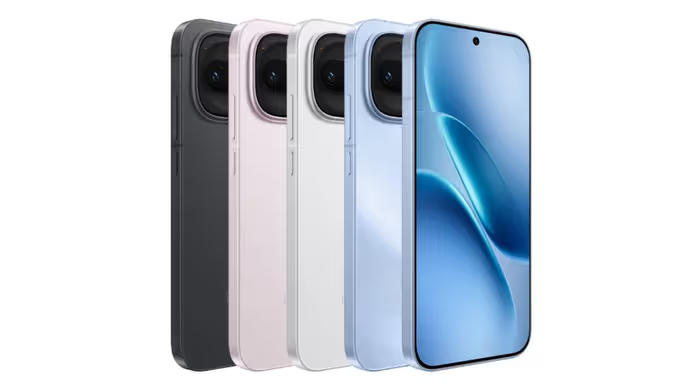
The iQOO Z11 Turbo comes in four colour options: Polar Night Black, Skylight White, Canglang Fuguang, and Halo Powder. The design follows iQOO’s familiar performance-driven aesthetic, with a sturdy build and a modern camera module that gives it a premium appearance.
iQOO is offering the smartphone in multiple RAM and storage configurations, ensuring there is an option for different user needs. Buyers can choose from variants going all the way up to 16GB RAM and 1TB storage, which is uncommon in this price segment.
Price in China
The iQOO Z11 Turbo starts at CNY 2,699, which roughly translates to Rs 35,000 for the 12GB RAM + 256GB storage variant. Other configurations include:
- 16GB + 256GB at CNY 2,999 (approx. Rs 39,000)
- 12GB + 512GB at CNY 3,199 (approx. Rs 42,000)
- 16GB + 512GB at CNY 3,499 (approx. Rs 45,000)
- 16GB + 1TB at CNY 3,999 (approx. Rs 52,000)
At these prices, the phone competes with upper mid-range and near-flagship devices, particularly in markets like India where brands such as OnePlus, Realme, and Samsung dominate the segment.
Snapdragon 8 Gen 5 Powers the Z11 Turbo
The standout feature of the iQOO Z11 Turbo is its Snapdragon 8 Gen 5 processor, Qualcomm’s latest high-performance chipset built on an advanced 3nm process. The chip is designed to deliver flagship-level performance while maintaining power efficiency, making it suitable for heavy gaming, multitasking, and prolonged usage.
Paired with LPDDR5x Ultra RAM and UFS 4.1 storage, the phone is clearly targeted at power users. Whether it’s demanding games, video editing, or switching between multiple apps, the Z11 Turbo is built to handle it all with ease.
This performance-focused approach aligns with iQOO’s brand identity, as the company has consistently marketed its Z-series devices toward gamers and users who prioritise speed and responsiveness.
Software and User Experience
Out of the box, the iQOO Z11 Turbo runs Android 16-based OriginOS 6, making it one of the earliest non-flagship smartphones to ship with the latest Android version. This not only improves overall usability but also enhances long-term software relevance.
OriginOS 6 brings refined animations, improved privacy controls, and system-level optimisations that complement the powerful hardware. While the global version, if launched, may run Funtouch OS instead, the core Android experience is expected to remain smooth and feature-rich.
Display: Built for Gamers
On the front, the iQOO Z11 Turbo sports a 6.59-inch 1.5K AMOLED display with a 144Hz refresh rate. The high refresh rate ensures ultra-smooth scrolling and an enhanced gaming experience, especially for competitive titles.
The panel supports HDR content and covers the P3 wide colour gamut, resulting in vibrant colours and strong contrast levels. Whether watching videos, playing games, or browsing social media, the display is one of the phone’s biggest strengths.
Adding to its premium credentials, the smartphone comes with IP68 and IP69 dust and water resistance, a feature rarely seen in this segment. It also includes a 3D ultrasonic fingerprint sensor, which is faster and more secure than traditional optical sensors.
Camera Setup: A 200MP Statement
The iQOO Z11 Turbo features a dual rear camera system, led by a massive 200MP primary sensor with optical image stabilisation (OIS). This high-resolution sensor is designed to capture detailed photos, particularly in good lighting conditions.
Supporting the main camera is an 8MP ultra-wide lens, useful for landscape shots and group photos. On the front, the device houses a 32MP selfie camera, capable of delivering sharp images and clear video calls.
The phone supports up to 4K video recording, making it suitable for content creators and vloggers. However, the absence of a telephoto lens may be a drawback for users who value optical zoom and portrait photography versatility.
Battery and Charging: One of the Biggest Highlights
Another major highlight of the iQOO Z11 Turbo is its 7,600mAh battery, which is significantly larger than what most competitors offer in this category. iQOO claims up to 23.1 days of standby time, suggesting that users can easily get two days of moderate to heavy usage on a single charge.
The device supports 100W fast charging, allowing the large battery to recharge quickly. This combination of massive battery capacity and fast charging makes the Z11 Turbo an ideal choice for gamers, travellers, and users who rely heavily on their smartphones throughout the day.
Potential India Launch and Competition
If the iQOO Z11 Turbo launches in India at a similar price point, it would likely fall within the Rs 35,000–40,000 range for the base model. This is a highly competitive segment where buyers expect near-flagship performance, solid cameras, and reliable software support.
However, iQOO already markets its Neo series in India, which could overlap with the Z11 Turbo’s positioning. This overlap raises uncertainty about whether the company will introduce the Z11 Turbo in the Indian market.
Final Thoughts
The iQOO Z11 Turbo is a bold smartphone that brings flagship-level performance to a lower price bracket. With its Snapdragon 8 Gen 5 chipset, 144Hz AMOLED display, 200MP camera, and massive 7,600mAh battery, it clearly caters to gamers and power users.
While photography enthusiasts might prefer alternatives with more versatile camera setups, users focused on performance, battery life, and display quality will find the Z11 Turbo highly appealing. If launched in India at competitive pricing, it could become one of the most compelling options in the premium mid-range smartphone segment.